
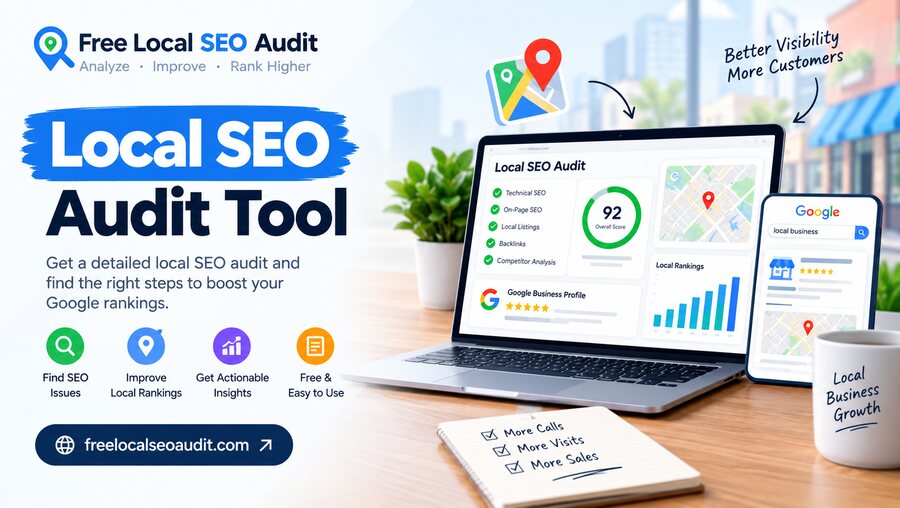
If you run a local business, your next customer is probably searching for you right now. They’re typing “plumber near me” or “best café in town” into Google, and the businesses that show up in the map pack are getting the calls. If you’re not there, a local SEO audit is the fastest way to find out why.
The good news? You don’t need an expensive agency or a monthly software subscription. With a free local SEO audit tool like Free Local SEO Audit, you can uncover what’s holding your business back and fix it yourself.
Here’s how I approach a complete local SEO audit, step by step.
What Is a Local SEO Audit?
A local SEO audit is a health check for your business’s visibility in local search results. It looks at everything Google uses to decide whether to show your business to nearby searchers, including:
- Your Google Business Profile
- Your website’s on-page SEO
- Your business citations (NAP: Name, Address, Phone)
- Your reviews and reputation
- Your local backlinks
- How you compare to local competitors
Think of it as a map of your strengths and weaknesses. Once you know where the gaps are, you know exactly what to work on.
Why Use a Free Local SEO Audit Tool?
You could check all of this manually, but it takes hours, and it’s easy to miss things. A good local SEO audit tool pulls the key data together in minutes, flags issues automatically, and gives you a clear starting point.
For small business owners and freelancers, a free tool like Free Local SEO Audit is ideal: you get actionable insights without spending a cent, and you can rerun the audit whenever you make changes.
Run Your Initial Audit
Head over to freelocalseoaudit.com and enter your business details. Make sure you use your business name, address, and website exactly as they appear on your Google Business Profile, since consistency matters.
Once the report is generated, don’t panic if you see a lot of red flags. Every business has room to improve. Save or screenshot your results, so you have a baseline to measure progress against later.
Review Your Google Business Profile
Your Google Business Profile (GBP) is the single most important factor in local rankings. Use your audit results and check that:
- Your profile is claimed and verified. An unverified profile is a missed opportunity.
- Your primary category is accurate. Choose the most specific category that describes your business, and add relevant secondary categories.
- Your business hours are correct, including holiday hours.
- Your description is complete and naturally mentions your services and location.
- You’ve added photos. Profiles with fresh, real photos tend to get more engagement.
- Services or products are listed with short descriptions.
- You’re posting updates regularly, even once a week helps show activity.
If your audit flags missing fields, fill them in first. These are quick wins.
Check NAP Consistency Across the Web
NAP stands for Name, Address, and Phone number. Google cross-references this information across directories like Yelp, Facebook, Bing Places, Apple Maps, and industry-specific sites.
If your business is listed as “Smith Plumbing LLC” in one place and “Smith’s Plumbing” with an old phone number in another, it creates confusion and can weaken trust in your listing.
Use your audit report to spot inconsistencies, then:
- Make a list of every directory where your business appears.
- Choose one “official” format for your NAP.
- Update each listing to match exactly.
- Remove or merge any duplicate listings.
This step is tedious, but it pays off.
Audit Your Website’s On-Page Local SEO
Your website needs to clearly tell Google what you do and where you do it. Check these elements:
- Title tags and meta descriptions include your main service and city (e.g., “Emergency Plumber in Austin | Smith Plumbing”).
- Your NAP appears on your website, usually in the footer and on a contact page, matching your GBP.
- You have location or service-area pages if you serve multiple cities.
- An embedded Google Map on your contact page.
- LocalBusiness schema markup to help search engines understand your business details.
- Mobile-friendliness and page speed. Most local searches happen on phones, so a slow or clunky site loses customers fast.
Fix any missing title tags or contact details first. Those are simple changes with real impact.
Analyze Your Reviews
Reviews influence both rankings and whether people actually choose you. Look at:
- How many reviews you have compared to competitors
- Your average star rating
- How recent your reviews are
- Whether you respond to reviews, both positive and negative
If you’re behind, create a simple process for asking happy customers for reviews: a follow-up email, a text with your review link, or a QR code at checkout. And always reply to reviews; it shows customers (and Google) that you’re engaged.
Look at Local Backlinks
Links from other local websites signal that your business is a real, trusted part of the community. Good sources include:
- Local chambers of commerce
- Community event sponsorships
- Local news sites and blogs
- Partner businesses and suppliers
- Local associations and clubs
Even a handful of relevant local links can make a difference in competitive areas.
Compare Yourself to Local Competitors
Search for your main service plus your city and see who appears in the top three map results. Then ask:
- How many reviews do they have?
- What categories are they using?
- How complete are their profiles?
- What does their website do that yours doesn’t?
You don’t need to copy them, but understanding the bar helps you set realistic goals.
Build an Action Plan
An audit is only useful if you act on it. Turn your findings into a simple prioritized list:
Quick wins (this week):
- Complete missing Google Business Profile fields
- Fix incorrect hours or phone numbers
- Add photos
- Update website title tags
Medium effort (this month):
- Clean up NAP inconsistencies
- Start a review request process
- Add schema markup
Ongoing:
- Post GBP updates weekly
- Respond to every review
- Build local links over time
Re-Audit Regularly
Local SEO isn’t a one-time job. Competitors change, listings get edited, and Google updates how it ranks businesses. I recommend running a fresh audit with your local SEO audit tool every one to three months, and after any major change like moving locations or rebranding.
Compare your new results to your baseline from Step 1. Watching those red flags turn green is genuinely satisfying.
Final Thoughts
Running a complete local SEO audit doesn’t have to be complicated or expensive. With a free tool like Free Local SEO Audit, you can see exactly where your business stands, fix the issues that matter most, and start showing up for the customers searching nearby.
Start with your audit today, knock out the quick wins, and build from there. Your future customers are already looking for you; make sure they can find you.